Anthropic and Google’s Billion‑Chip Deal Signals AI Infrastructure Arms Race
On 23 October 2025, Anthropic announced a landmark deal with Google LLC to deploy up to one million of Google’s Tensor Processing Units (TPUs), marking a significant escalation in the infrastructure race underpinning advanced artificial intelligence. (Reuters)
This deal not only underscores soaring demand for AI hardware — but also highlights how supply‑chains, geopolitics and business strategy are converging around compute‑power as the new battleground.
1. The deal in brief Anthropic Google TPU deal 2025
According to the announcement, Anthropic will gain access to over one gigawatt of TPU capacity starting in 2026, built on Google Cloud infrastructure. (Reuters)
The move is widely interpreted as a direct response to the constrained supply of accelerators from established vendors like Nvidia and AMD, and a strategic attempt to secure large‑scale compute for the next generation of its Claude AI models.
By locking in dedicated TPU capacity, Anthropic gains a hedge against longer lead‑times, volatile memory and packaging supply, and rising competition for chip‑fabrication throughput. This aligns with broader signals that the era of “just renting GPUs” is giving way to vertically integrated, long‑term hardware commitments.
2. Why it matters for the AI industry
Supply chain pressure: The fact that a major AI player is securing one million TPUs at scale emphasises how scarce high‑end computing assets have become — much more than typical cloud demand.
Hardware as strategic moat: Compute capacity is no longer just a cost centre — it is a competitive advantage. Entities that control large pools of TPUs or equivalent accelerators can scale models faster, offer lower latency, and reduce reliance on third parties.
Industry tilt: Google’s role is evolving from infrastructure provider to compute‑platform strategist. By renting or selling TPUs to third‑parties like Anthropic, Google positions itself as a hardware enabler in the AI ecosystem, not just a cloud vendor.
For deeper context around hardware trends, see our analysis of AI hardware trends 2025.
3. Implications for the AI chip shortage
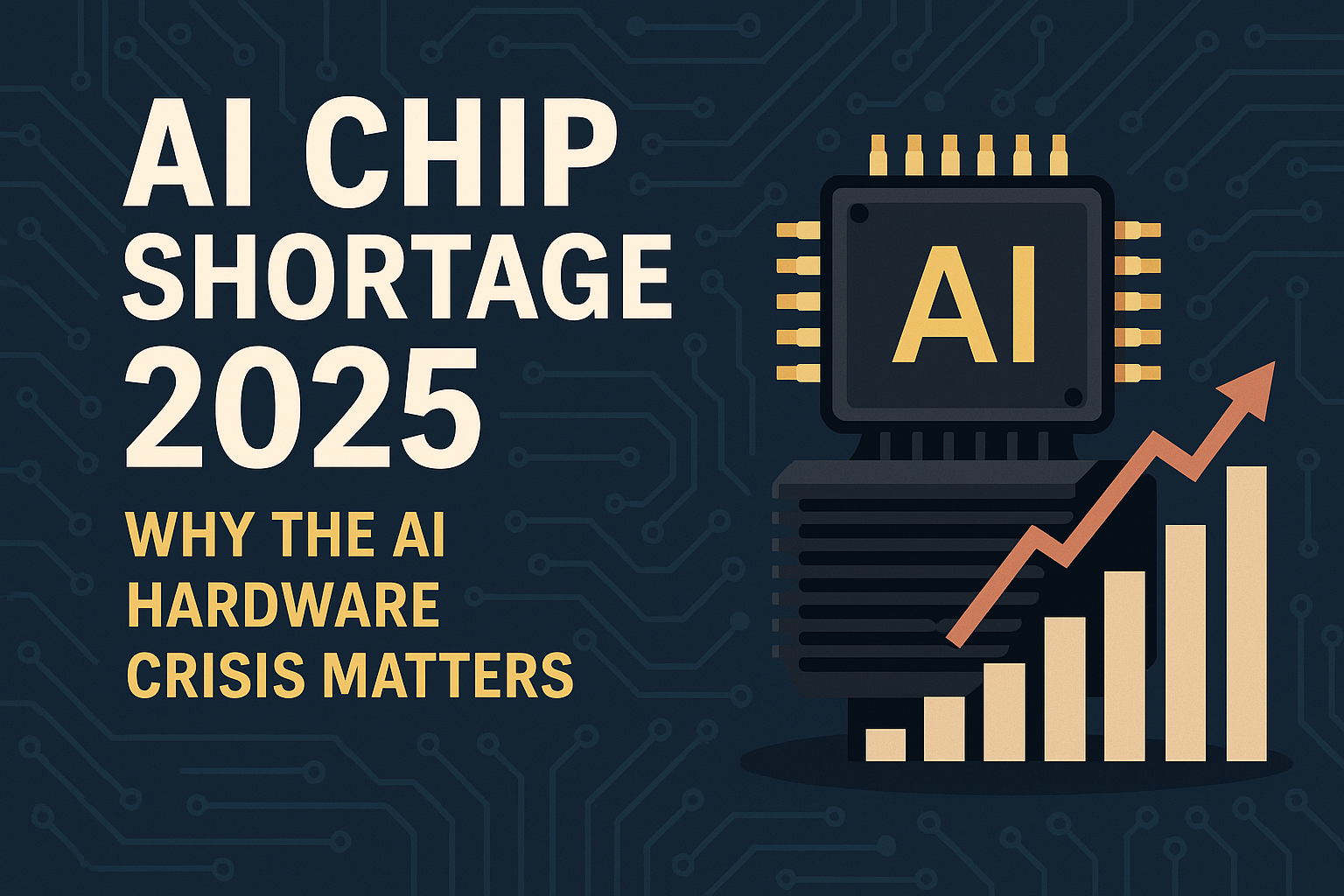
This deal shines a spotlight on one of the most pressing challenges facing AI: the hardware bottleneck. Industry analysts have long warned that memory, packaging, substrate and accelerator lines are under strain as AI workloads grow exponentially.
The ramp‑up commitment from Anthropic indicates the market is expecting not just incremental growth — but a sustained surge in demand over multiple years. In turn, this feeds into the narrative of the AI chip shortage 2025 that we recently discussed.
Higher demand means longer lead times, higher spot prices and stronger incentive for major players to lock in supplies early. Startups and smaller players risk being starved of capacity unless they pre‑book or diversify. For more on supply‑chain consequences, see our piece on global AI supply chain risks.
4. What to watch next Anthropic Google TPU deal 2025
- How quickly will the TPUs be delivered and integrated?
- Will Anthropic move toward custom silicon?
- Competitor reactions — new infrastructure deals or pricing changes.
- Memory and packaging availability as upstream bottlenecks.
Conclusion
The Anthropic–Google TPU deal marks a major milestone in the infrastructure era of AI. It emphasises that the battle for model dominance will not be won simply by algorithmic breakthroughs, but by having ready access to massive pools of compute.
In the context of the wider AI chip shortage 2025, the event sends a clear message: hardware supply has become a strategic front line.